




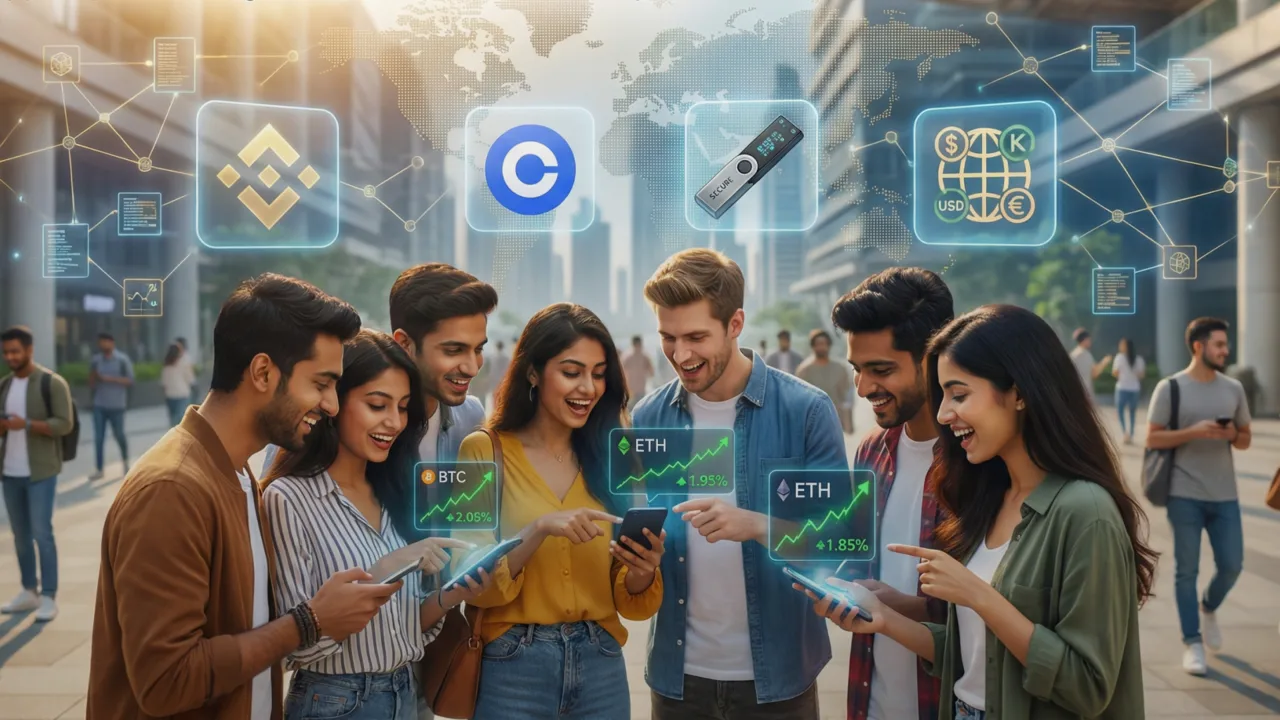
If you are reading this, you have likely done your homework. You know what cryptocurrency is, and you understand the difference between Bitcoin and Ethereum.
- Preparation (Before You Buy Cryptocurrency)
- Phase 2: Choose Your Exchange (Global vs. Local)
- Phase 3: The Step-by-Step Buying Process
- Step 1: Create Account & AI Verification
- Step 2: Deposit Funds (Select Your Method)
- Step 3: Place Your Buy Order
- Phase 4: Post-Purchase Security
- Phase 5: Advanced Tips & Risks (The “Pro” Safety Checklist)
- 1. The “Hidden” Fee: Understanding the Spread
- 2. Interface Overload: Lite vs. Pro Mode
- 3. Smart Investing: Dollar Cost Averaging (DCA)
- 4. Tax Hygiene: The “Save Receipt” Habit
- 5. The “Golden Rule” of Security
- Start Small, Think Big before investing on Cryptocurrency
Now, you are ready to put skin in the game.
In the early days, buying Bitcoin required wiring money to shady offshore accounts. In 2026, purchasing cryptocurrency is as easy as ordering a pizza. Whether you are in New York using a bank transfer or in a region using P2P options, the process is regulated, secure, and takes less than 30 minutes.
This guide is your cockpit. We will ignore complex trading tools and focus on one goal: Getting your first crypto asset safely into your portfolio.
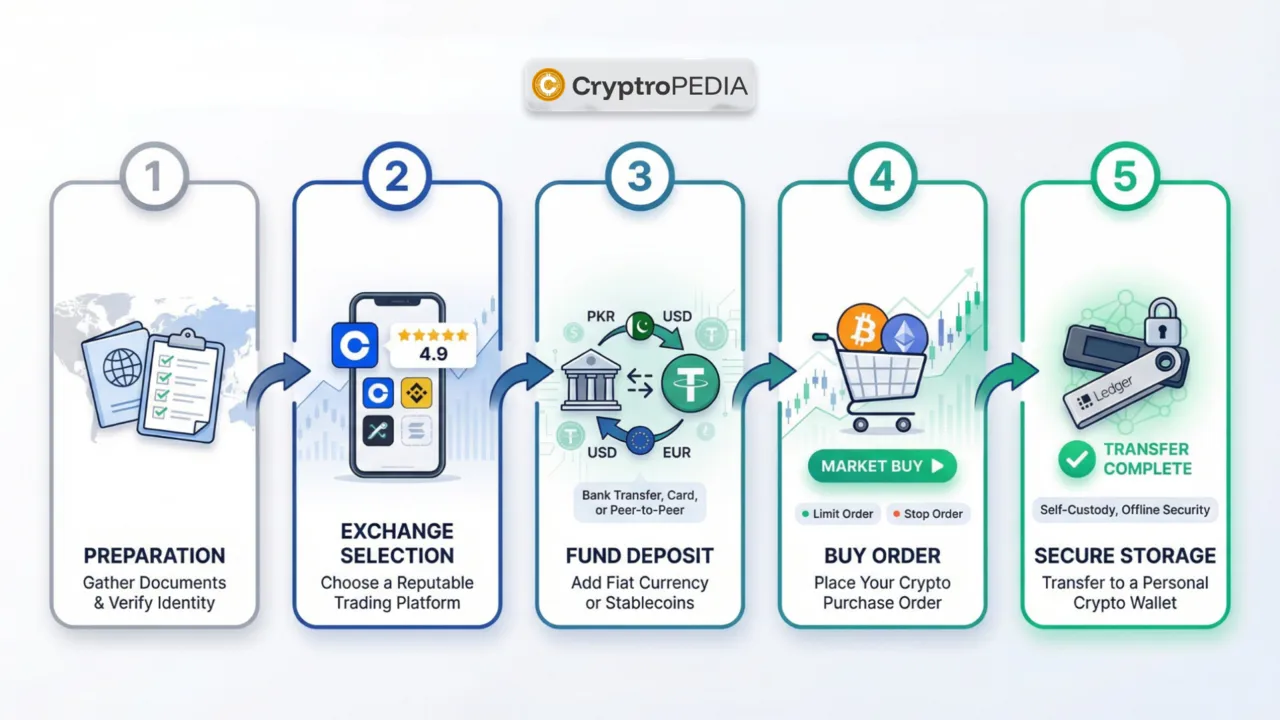
Preparation (Before You Buy Cryptocurrency)
Don’t rush in. Ensure you have these four essentials ready before you start the signup process to avoid delays.
1. The Essential Checklist
- Government ID: Passport, Driver’s License, or National ID. (Required for “KYC” – Know Your Customer laws).
- Payment Method:
- Global: Bank Account or Credit/Debit Card.
- Restricted Regions: Local mobile wallet apps (for P2P trading).
- Secure Connection: Never buy crypto on public Wi-Fi (like a coffee shop). Use home Wi-Fi or mobile data.
- Risk Capital: The Golden Rule is “Invest only what you can afford to lose.” We recommend beginners start with $50–$500.
Phase 2: Choose Your Exchange (Global vs. Local)
A Cryptocurrency Exchange is the marketplace where you trade your fiat currency (USD, EUR, etc.) for crypto. In 2026, the best exchange for you depends on where you live.
| Exchange | Best Region | Best For | Fees (Spot) |
| Coinbase | US / EU | Education & Safety. The “Apple” of crypto. Easiest to use but slightly higher fees. | 0.5% – 3.99% |
| Binance | Global / Asia | Low Fees & P2P. Massive variety (600+ coins). Best for users in Asia, Africa, or regions with strict banking rules. | 0.1% |
| Kraken | EU / US | Security. Never been hacked. excellent 24/7 human support. | 0.16% – 0.26% |
| Bybit / OKX | Global | Trading Tools. Great alternatives if Binance is restricted in your area. | ~0.1% |
You might notice the ‘Buy’ price is slightly higher than the market price shown on the chart. This is called the ‘Spread.’ It’s a hidden fee exchanges charge to guarantee your order fills instantly.
Pro Tip: If you are in the USA or Europe, start with Coinbase. If you are in Asia, Africa, or the Middle East, Binance or Bybit are often better choices due to their P2P (Peer-to-Peer) markets.
Phase 3: The Step-by-Step Buying Process
We will use a standard exchange flow (like Coinbase/Binance) as our example. Where Most exchanges (Binance, Coinbase, OKX) have two modes: Lite (Simple) and Pro (Complex).
Step 1: Create Account & AI Verification
Exchanges use AI-powered identity verification in 2026.
- Sign Up: Enter your email and set a strong, unique password.
- Verify ID: You will be asked to take a photo of your ID and a “liveness” selfie. The AI usually approves this in under 5 minutes.
- Secure: Enable 2FA (Two-Factor Authentication) immediately using an app like Google Authenticator. Do not skip this.
Step 2: Deposit Funds (Select Your Method)
How do you get money onto the platform?
- Option A: Bank Transfer (ACH/SEPA)
- Cost: Free or Low Fee.
- Speed: 1–3 Days.
- Best For: Large deposits where you want to save on fees.
- Option B: Debit/Credit Card
- Cost: High (2% – 4% processing fee).
- Speed: Instant.
- Best For: Small, urgent purchases ($50–$100).
- Option C: P2P Trading (Peer-to-Peer)
- Cost: 0% Platform Fee (Rates vary by seller).
- Speed: 10–30 Minutes.
- Best For: Users whose local banks block crypto. You send cash/mobile money to a verified seller, and the exchange releases their crypto to you (Escrow).
Step 3: Place Your Buy Order
- Select Asset: Stick to Bitcoin (BTC) or Ethereum (ETH) for your first buy. Avoid volatile meme coins.
- Choose Order Type: Select “Market Order” (buys instantly at current price).
- Enter Amount: Type “$50” (or your budget). You will see you get a fraction of a coin (e.g., 0.0005 BTC).
- Confirm: Review the fee preview and click “Buy.”
Congratulations! If you are following properly then now you officially own cryptocurrency.
Phase 4: Post-Purchase Security
You bought it. Now, where is it? Right now, your crypto is sitting in the Exchange’s Wallet (Custodial).
- Small Amounts ($50–$500): It is generally safe to leave on a top-tier exchange (Coinbase/Binance).
- Large Amounts ($1,000+): Move it to a Personal Wallet. If the exchange gets hacked or banned, your money is gone.
Next Read: Learn how to take full control in Article 5: Crypto Wallets Explained (Hot vs. Cold).
Phase 5: Advanced Tips & Risks (The “Pro” Safety Checklist)
You have successfully purchased your first cryptocurrency. Before you celebrate, you need to “future-proof” your investment against hidden costs, tax headaches, and security pitfalls.
1. The “Hidden” Fee: Understanding the Spread
You might notice that if Bitcoin is trading at $95,000, your buy price might be $95,200. You didn’t get ripped off—this is the Spread.
- What it is: The difference between the market price and the price you pay.
- Why it happens: Exchanges often charge a small premium (0.5% – 1%) to guarantee your “Market Order” fills instantly.
- Pro Tip: Always review the final estimated cost on the confirmation screen before clicking “Buy.”
2. Interface Overload: Lite vs. Pro Mode
Most modern exchanges (Binance, Coinbase, OKX) have two interface modes.
- Lite Mode: Simplified, easy buttons, less data. Use this for your first buy.
- Pro Mode: Complex charts, depth order books, and trading jargon.
- Recommendation: If your screen looks like a spaceship cockpit and you feel overwhelmed, look for a toggle in your ‘Settings’ or ‘Profile’ to switch back to “Lite” or “Standard” mode.
3. Smart Investing: Dollar Cost Averaging (DCA)
Instead of trying to “time the market” (guessing when the price is lowest), use DCA.
- The Strategy: Instead of buying $500 at once, buy $50 every week for 10 weeks.
- The Benefit: This smooths out your average entry price. If the market crashes tomorrow, you haven’t lost everything—you just get to buy cheaper next week!
4. Tax Hygiene: The “Save Receipt” Habit
In most countries, simply buying crypto is not a taxable event. However, selling it for a profit later triggers Capital Gains Tax (15%-30%).
- The Trap: Users often sell years later but have lost their original purchase records, making it impossible to calculate profit.
- Immediate Action: Right now, go to your exchange’s “Transaction History” and download the CSV or PDF statement of today’s purchase. Save it in a secure folder named “Crypto Tax Records.”
5. The “Golden Rule” of Security
- Support Scams: No legitimate exchange “Support Agent” will ever message you first on Telegram, WhatsApp, or Twitter.
- The Red Flag: If anyone asks for your password, 2FA code, or asks you to “synchronize your wallet,” it is a scam. Block and report them immediately.
Start Small, Think Big before investing on Cryptocurrency
Buying your first crypto is the first step into a new financial world. You have bypassed the traditional banking system and taken ownership of a digital asset.
Your Next Move: Now that you have assets, you need to understand where to store them long-term. Do you need a hardware device, or is an app on your phone enough?
👉 Next Step: Read our guide on Crypto Wallets Explained: Hot Wallets vs. Cold Wallets.
What is the minimum amount I can buy?
Usually between $2 and $10, depending on the exchange. You do not need to buy a whole Bitcoin.
What are the total fees?
Expect to pay 1%–4% total (Exchange fee + Payment processing fee) depending on your method. P2P is often the cheapest way to deposit.
Is P2P safe?
Yes, if you use the exchange’s official P2P platform (like Binance P2P) because they use Escrow. Never send money to someone outside the platform.
What if the market crashes right after I buy?
This is normal in crypto. If you believe in the long-term value, a crash is just a “discount.” This is why we hold for the long term.